
Kimia Restoration Of Reinforced Concrete Elements Even In High Thicknesses
RESTORATION OF REINFORCED CONCRETE ELEMENTS EVEN IN HIGH THICKNESSES WITH POURABLE MORTARS
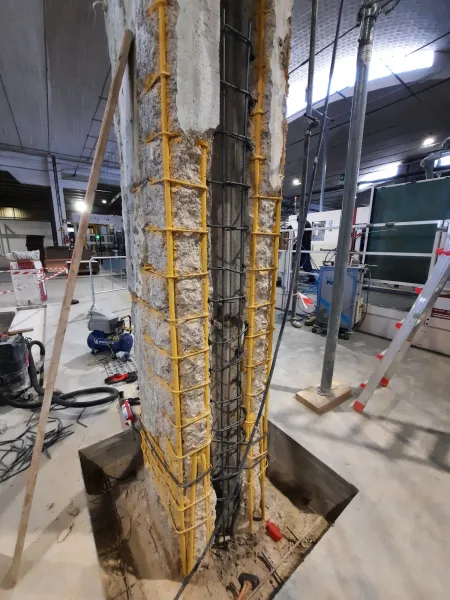
RESTORATION OF REINFORCED CONCRETE ELEMENTS EVEN IN HIGH THICKNESSES WITH POURABLE MORTARS
Reinforced concrete structures can be restored by casting a non-shrinking cementitious grout with a pourable consistency, after brushing on the metal reinforcements with anti-corrosive mortar.
Before casting, the formwork must be prepared, both the formwork and the area to be treated must be saturated with water and any stagnant water must be eliminated.
INFORMATION
BRAND
Kimia
FEATURES
Excellent grip
PRODUCT TYPE
Reinforced Concrete
EXCELLENT WORKABILIT
Excellent workability and ease of application
RPLACEMENT OF NEW REINFORCEMENT AND FORMWORK
Possibly install new metal reinforcement or electro-welded mesh if the existing reinforcing bars are significantly oxidized, resulting in a significant reduction in cross-section. If necessary, prepare formwork.
MATERIAL
Cement
HIGH PROTECTION
High protection of the armour
COLLECTION
Restoration
DURABILITY
Durability and resistance to environmental aggressions
OPERATIONAL PHASES
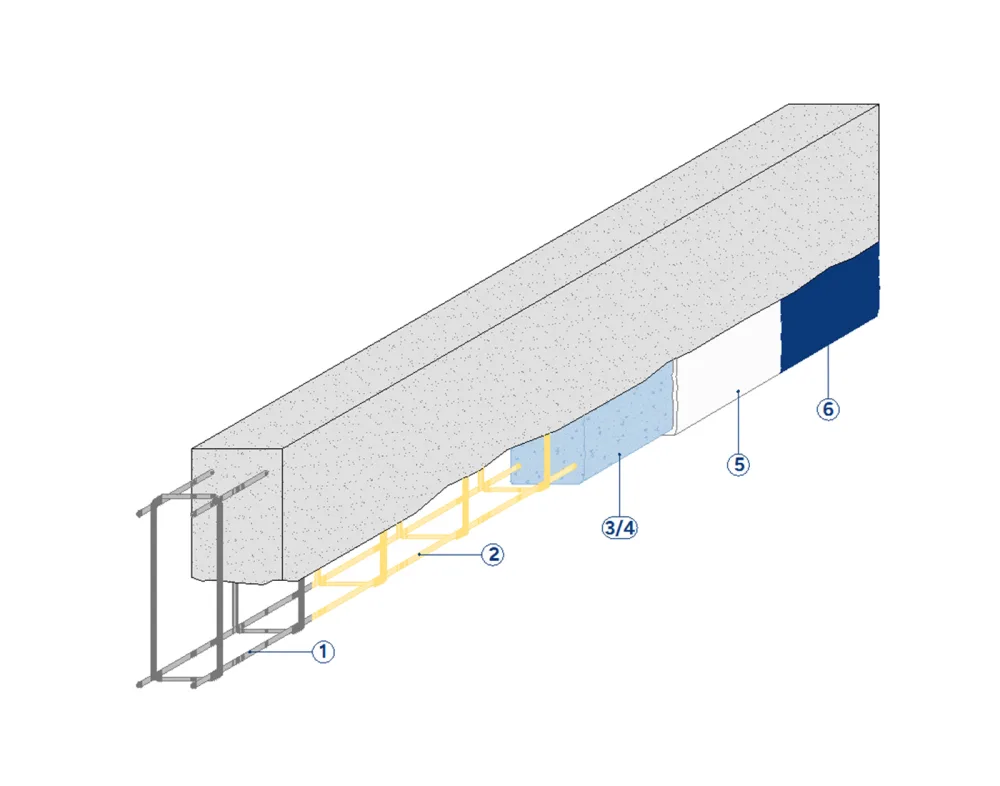
- 1 Removal of damaged concrete
- 2 Treatment of reinforcing bars
-3 Placement of new reinforcing bars and formwork
- 4 Casting
- 5 Smoothing
- 6 Protective painting
SCREENING
Apply any protective skim coat with a double coat of BETONFIX RS single-component mortar. To increase the durability of the skim coat, KIMITECH 350 fiberglass mesh can be placed between the two coats of skim coat.
c) Repairing thick layers with pourable mortars
PRODUCTION
Made in Italy
DOWNLOADS
↓ Application Sheet
↓ Construction Detail
REMOVAL OF AFFECTED CONCRETE
Completely remove the damaged concrete to obtain a solid substrate, free of loose particles and sufficiently rough. Remove the metal reinforcement from the concrete on all sides. Remove any residue of old paint, dirt, formwork, moss and/or lichen, dust, and loose materials in general that would prevent the mortar from adhering properly to the substrate.
DETAIL
The work continues with the smoothing to be carried out by applying a double coat of single-component mortar and ends with the protective anti-carbonation paint using a single-component elastomeric resin.
APPLICATION
PROTECTIVE TREATMENT OF REINFORCEMENT BARS
Carry out the protective treatment of exposed reinforcement bars by applying single-component realkalizing hydraulic mortar Betonfix KIMIFER with a CE mark in conformity with UNI EN 1504-7, applied with a brush, according to the consumption rates in the Technical Data Sheet, on the metal reinforcement to be protected.
PLACEMENT OF CONNECTING DOWELS AND CONSTRUCTION OF THE FORMWORK
Possible placement of new metal reinforcement or electro-welded mesh collaborator in the case of significant oxidation of the existing irons with strong reduction of the section and grout it with special epoxy resins or cement grout (consult our Technical Office). If necessary, prepare the formwork; it is recommended to treat it with release agent
TREATMENT OF THE EXISTING METAL REINFORCEMENT
Perform the brushing of exposed reinforcing bars or proceed with hydro-sandblasting in order to remove the rust and bring the surface to “white-metal” condition (hydro-sandblasting is not necessary if the preparation of the surface has been carried out by hydro-scarification, but it is necessary when a long period of time elapses from this operation due to particular organizational requirements of the site, before the treatment of the reinforcing bars).
SKIMMINGY
Possible protective skimming by applying a double coat of single-component mortar Betonfix RS with CE mark in conformity with UNI EN 1504-3 Class R2, for an average total thickness of 3 mm finished with trowel or sponge. The substrate will be cleaned in order to eliminate traces of release agent and roes of cement on the surface. Alternatively, single-component mortar Betonfix RS can be replaced with two-component elastic protective cement-based mortar Kimicover DUO with the CE mark according to UNI EN 1504-2. In order to increase the durability of the skimming, fiberglass mesh Kimitech 350 can be placed between the two layers of skim coat.
REMOVAL OF THE DAMAGED CONCRETE
The surfaces to be restored must be prepared by completely removing the damaged concrete by hand or mechanical chipping or by other suitable means such as hydro-scarifying, in order to obtain a solid support, free of loose parts and sufficiently rough. The concrete in contact with the visible metal reinforcements must be removed from each side of bars using a needle gun; the areas to be skimmed will be preliminarily sanded and / or water sandblasted to eliminate any residue of old paint, dirt, disarming, mosses and / or lichens, dust, friable materials in general that would prevent the perfect adherence of the mortar to the substrate.
FINAL PROTECTIVE COAT
Once the substrate is cured, carry out the anti-carbonation protective coating of the reinforced concrete structure through the use of single-component acrylic resin Kimicover BLINDO with CE mark according to UNI EN 1504-2. The resin will be diluted with 10-15% of drinking water and will be applied in a double layer by brush, roller or spray respecting the consumption rates indicated in the Technical Data Sheet.
POURING OF THE CASTING
Wet both the formwork and the area to be treated to saturation and eliminate, at the time of casting, any stagnant water (s.s.a condition) by hydro-washing. Mix Betonfix CR, CE marked according to UNI EN 1504-3 Class R4, with a concrete mixer for about 5 minutes, introducing 3/4 of the necessary water and then the product with the remaining water until the desired consistency is obtained. Respect the consumption indicated in the Technical Data Sheet.
The fills must have a suitable contrast reinforcement anchored to the existing structure with a minimum concrete cover of 2 cm. For thicknesses greater than 10 cm, mix Betonfix CR with approximately 30 % of washed siliceous aggregate, free of impurities, with a minimum grain size greater than 10 mm and maximum diameter depending on the thickness of the casting. After the demolition, it is advisable to wet the surfaces and in the case of high temperatures and excessive ventilation, cover the elements with sheets, to avoid excessive evaporation of the mixing water.