
Kimia Reinforcement Of Reinforced Concrete Elements
REINFORCEMENT OF REINFORCED CONCRETE ELEMENTS BY MEANS OF JACKETING WITH FIBRE-REINFORCED CONCRETE
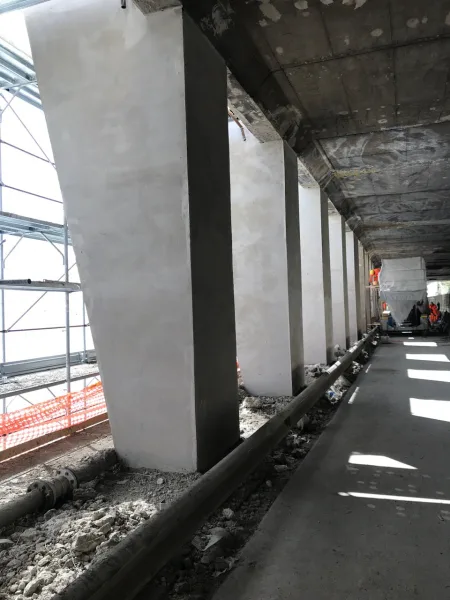
REINFORCEMENT OF REINFORCED CONCRETE ELEMENTS BY MEANS OF JACKETING WITH FIBRE-REINFORCED CONCRETE
According to the criterion of the hierarchy of resistances (Capacity Design), the pillars are the structural elements that must resist the seismic stresses the most to ensure that the structure does not collapse.
During the design phase they are subject to forces that are amplified in favor of safety, therefore their reinforcement also during the safety phase is essential.
INFORMATION
BRAND
Kimia
FEATURES
Excellent grip
PRODUCT TYPE
Reinforced Concrete
FIBERS
Micro-reinforcement of metal fibers
REMOVING DETERIORATED CONCRETE
Completely remove damaged concrete to obtain a solid substrate, free of loose particles and sufficiently rough. Remove metal reinforcement from the concrete on all sides. Remove any old paint, dirt, release agent, moss and/or lichen, dust, and any loose material that could prevent the mortar from adhering properly to the substrate.
MATERIAL
Cement
HIGH MECHANICAL RESISTANCE
High mechanical resistance to compression and flexion
POURING THE CASTING
Wet both the formwork and the area to be treated until saturated.
OPERATIONAL PHASES
- Casting
- Formwork
- Preparation of the support
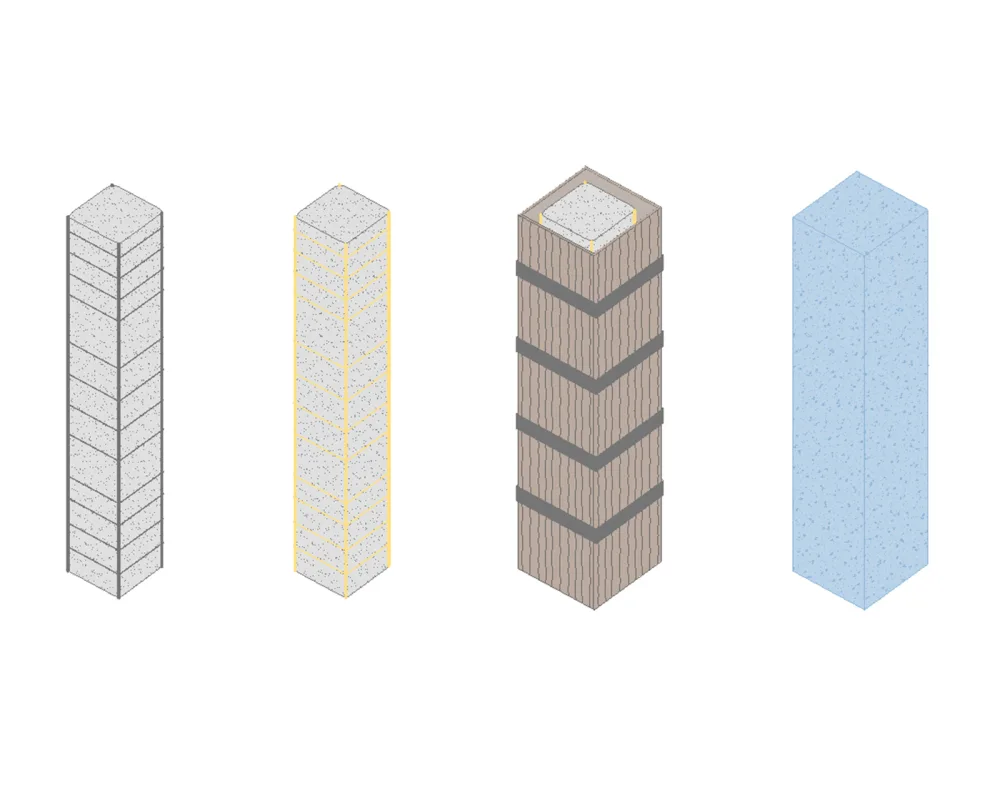
DETAIL
In case of need to increase the sections, after the passivation of the irons, it is possible to proceed with the thickening, after appropriate formwork, applying the system of fiber-reinforced mortar with micro-reinforcement of metal fibers. Increasing the resistant section of the pillar will increase its confinement and its ductility.
PRODUCTION
Made in Italy
DOWNLOADS
↓ Application Sheet
↓ Construction Detail
PLACEMENT OF NEW REINFORCEMENT AND FORMWORK
Possibly install new metal reinforcement or electro-welded mesh if the existing reinforcement is significantly oxidized, resulting in a significant reduction in cross-section. To improve the connection between the casting and the existing structure, insert point-connection systems on each face of the column. Create the formwork within which the casting will be performed.
REINFORCEMENT TREATMENT
Remove rust from exposed reinforcing bars and bring the surface to amicro-reinforcement of metal fibers. White metal finish. Apply protective treatment by brushing on, a single-component.
APPLICATION
PROTECTIVE TREATMENT OF REINFORCEMENT BARS
Carry out the protective treatment of exposed reinforcement bars by applying single-component realkalizing hydraulic mortar Betonfix KIMIFER with a CE mark in conformity with UNI EN 1504-7, applied with a brush, according to the consumption rates in the Technical Data Sheet, on the metal reinforcement to be protected.
PLACEMENT OF CONNECTING DOWELS AND CONSTRUCTION OF THE FORMWORK
To improve the degree of connection between the casting and the existing structure, punctual connection systems will be added by inserting dowels on each face of the pillar, every 50 cm (at staggered heights on the various faces). The presence of punctual connectors allows to redistribute the stresses on the fiber-reinforced casting even in the absence of a subdivision mesh, thanks to the presence of the metal fiber.
TREATMENT OF THE EXISTING METAL REINFORCEMENT
Perform the brushing of exposed reinforcing bars or proceed with hydro-sandblasting in order to remove the rust and bring the surface to “white-metal” condition (hydro-sandblasting is not necessary if the preparation of the surface has been carried out by hydro-scarification, but it is necessary when a long period of time elapses from this operation due to particular organizational requirements of the site, before the treatment of the reinforcing bars).
REMOVAL OF THE DAMAGED CONCRETE
The surfaces to be restored must be prepared by completely removing the damaged concrete by hand or mechanical chipping or by other suitable means such as hydro-scarifying, in order to obtain a solid support, free of loose parts and sufficiently rough. The concrete in contact with the visible metal reinforcements must be removed from each side of bars using a needle gun; the areas to be skimmed will be preliminarily sanded and / or water sandblasted to eliminate any residue of old paint, dirt, disarming, mosses and / or lichens, dust, friable materials in general that would prevent the perfect adherence of the mortar to the substrate.
POURING OF THE CASTING
The mixing of Betonfix HCR EVO can be carried out in a simple cement mixer or preferably with a mechanical mixing unit. Insert half of part A (powder) and start mixing adding half the amount of water shown in the table. Mix until a homogeneous and fluid mixture is obtained, then insert the remaining part of the powder gradually adding the remaining part of water until the desired mixing ratio is obtained. Keep of mixing for at least another 5 minutes.
Weigh the quantity of fibers required in relation to the volume of the pouring to be made and add them gradually (over a period of about 3 minutes), using special fiber unraveling equipment. Insert all the fibers, mix for at least another 2- 3 minutes. Pour Betonfix HCR EVO. To facilitate the filling of the formworks make a slight mechanical vibration or beating. Where necessary, use bars or rods to facilitate the spreading of the mortar. After the formwork's removal, it is advisable to wet the surfaces and in the case of high temperatures and excessive ventilation, cover the elements with sheets, to avoid excessive evaporation of the mixing water.