

Laterlite Water Management, Flood Protection, Drainage
WATER MANAGEMENT, FLOOD PROTECTION, DRAINAGE
WATER MANAGEMENT, FLOOD PROTECTION, DRAINAGE
Water management is affected by climate change which is bringing about ever more frequent and more intense rainfall, with peak water flows that exceed the capacity of drainage networks and surface watercourses.
information
SYSTEMS
Stormwater infiltration chamber systems
BRAND
Laterlite
PRODUCT TYPE
Flood Protection, Drainage
STRUCTURE
Rainwater harvesting support structure
STORM WATER INFILTRATION CHAMBERS – RAINWATER HARVESTING
To regularise peak storm water flows, a simple underground accumulation and infiltration chamber can be constructed by burying a volume of expanded clay.
PEAK FLOWS
Peak flows exceed capacity
RAINFALL EVENTS
Increased intense rainfall events
ENVIRONMENT
Outdoor
FLOODING
Risk of flooding increases
WATER MANAGEMENT
Climate change impacts water management
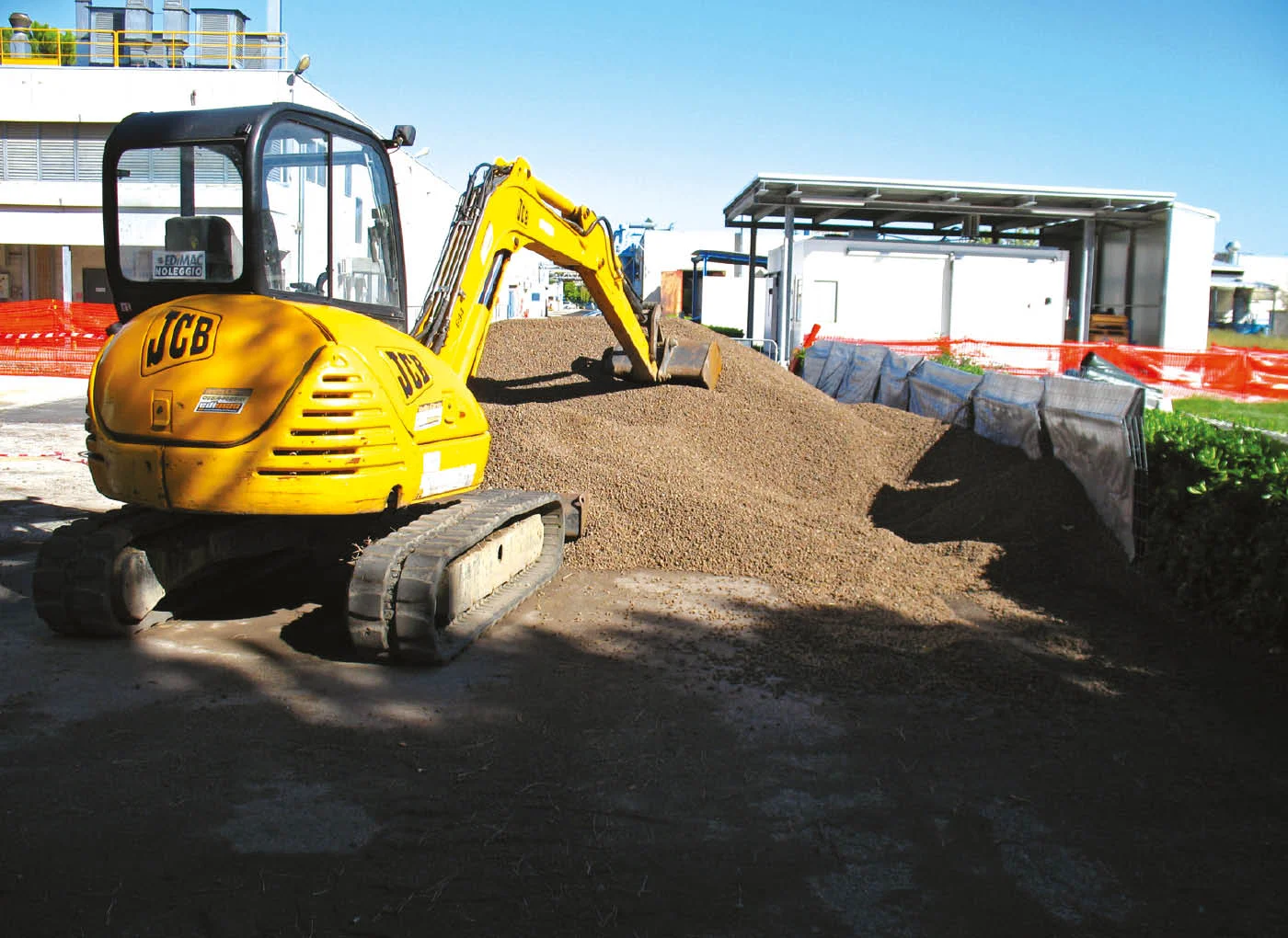
DRAINAGE BELOW PLAYING FIELDS
The use of expanded clay in the drainage systems below playing fields prevents flooding, allows the field to be used in adverse weather conditions, and prevents the ground from settling.
SLOPES
Stabilizes silty clay slopes
PEAK WATER FLOW
Regulates peak water flow
DRAINAGE TRENCHES
Expanded clay is used trenches in various situations to construct drainage, particularly for stabilising slopes that consist of silty clay material.
PRODUCTION
Made in USA
PROTECT INHABITED
Protect inhabited areas effectively
INHABITED AREAS
It is therefore very important to realise flood protection and drainage systems to avoid overflows and flooding of inhabited areas and agricultural zones.
GREEN ROOFS
The use of expanded clay in the layers of a correctly designed green roof (consisting of a drainage, a substrate, and a mulching layer) improves plant health and significantly reduces peak water discharge into the public drain during intense rainfall.
FIELD DRAINAGE
Improves playing field drainage
REDUCES STORMWATER
Reduces stormwater discharge peaks
DETAIL
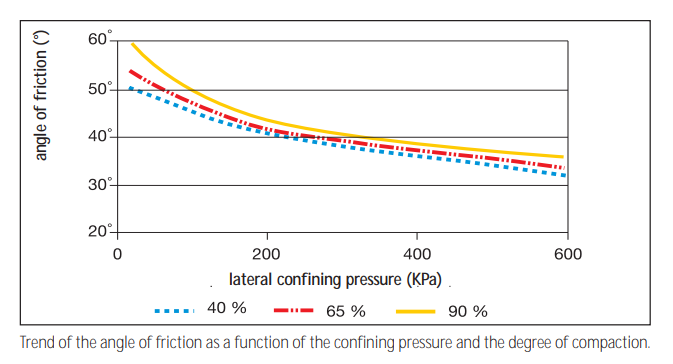
ANGLE OF INTERNAL FRICTION
The angle of friction of unbounded expanded clay is obtained from triaxial tests by varying the lateral confi ning pressure of the aggregate and its degree of compaction. For design purposes, with a confi ning pressure of 200 kPa (which is typical of the most important geotechnical applications), a value of approximately 40° can be assumed.
SURFACE STIFFNESS OF EMBANKMENTS – PLATE LOADING TESTS
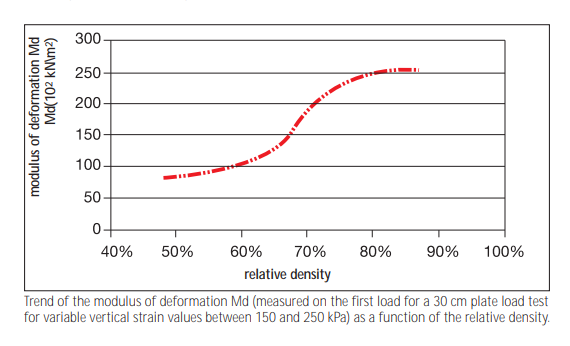
The surface stiffness of expanded clay embankments is determined by plate load testing. The stiffness values obtainable will depend on the technical solution chosen, the grain size of the expanded clay, and the degree of compaction. The various methods for constructing an embankment are described in detail in Section 2. In general these include a finishing layer to distribute the loading.
The graph shows the trend of the modulus of deformation Md as a function of the relative density, for an 80 cm thick layer of type 0/30 expanded clay finished with 20 cm of granular mix. If necessary, an asymptotic value of Md = 200 Kg/cm2 can be considered for design purposes, which corresponds to a degree of compaction of the aggregate that is easy to attain using ordinary ground-compacting machinery (plate vibrators, compaction rollers).
SUSTAINABILITY
Laterlite Expanded Clay, as well as the rest of our range, are manufactured using the Best Available Technology (BAT) that uses natural resources effi ciently, obtaining more than 5 m³ of expanded clay from 1 m³ of our abundant natural local clay. We operate an environmental management system that complies with voluntary international standard ISO 14001:2004, and Health and Safety Management Best Practice that meets British Standard BS OHSAS 18001.
Whilst we are continuing to reduce emissions from our manufacturing plants, for some time we have also been implementing a long-term programme of further development to make them more energy-effi cient. At all of our factories we have replaced fossil fuels with alternative recycled combustibles and/or biomass, whilst a signifi cant part of the electrical energy we use is now generated on site from renewable sources.
Laterlite is a partner member of the CASA CLIMA energy certifi cation agency and is actively involved in promoting energy effi ciency as a member of the Green Building Council for Italy: promoting the retention and upgrading of existing buildings and encouraging sustainability throughout the construction Industry supply chain. Most of our products are certifi ed by ANABICEA, the Italian Accreditation Institute, for use in sustainable construction.
WATER ABSORPTION AND DRAINAGE
Laterlite Expanded Clay is an inert, vitrifi ed, dimensionally stable material whose volume remains unchanged in contact with water. When the inter-granular voids (i.e. the voids between the granules, which interconnect with one another) are immersed in water they immediately become saturated; the intra-granular pores (the voids within each granule) only fi ll more slowly with water by capillary action, and some of them will never become saturated.
The excellent drainage capacity of expanded clay is due to this network of intergranular pores, whilst the water absorption is due to the intra-granular pores. In accordance with European Standard EN 13055-2 (par. 4.8), the coeffi cient of water absorption of expanded clay is determined by immersing a dry sample in water for 24 hours.
Comparison of its weight before and after the test (of the drained material) gives the quantity of water that has been absorbed by the granules (this will vary, depending on the grain size). For design purposes, the coeffi cient of water absorption of Laterlite Expanded Clay can be conservatively considered as always less than 25% by weight. Laterlite Expanded Clay is also available in the special Laterlite Plus dry hydrophobic variant, which maintains its extremely low coeffi cient of water absorption over time.
