
Kimia Waterproofing Of Tanks And Reservoirs
WATERPROOFING OF TANKS AND RESERVOIRS
WATERPROOFING OF TANKS AND RESERVOIRS
Waterproofing of tanks and reservoirs, also for the containment of drinking water, food liquids or aggressive products
INFORMATION
BRAND
Kimia
PRODUCT TYPE
Waterproofing
AGGRESSIVE AGENTS
Contains no chlorides or aggressive agents
FEATURES
- Ease of application
- Seals cracks in the substrate
WATERPROOFING TANKS CONSISTS
Waterproofing tanks consists of the use, after preparing the support, of a glass fiber mesh saturated with osmotic cement mortar, mixed with synthetic resin. Once hardened, a second coat of product is applied with a spatula.
MATERIAL
Cement
SUITABLE
Suitable for underground tanks
PRIMING
Apply kimicover fix mv primer to the surface to be waterproofed.
OPERATIONAL PHASES
- Waterproofing
- Substrate preparation
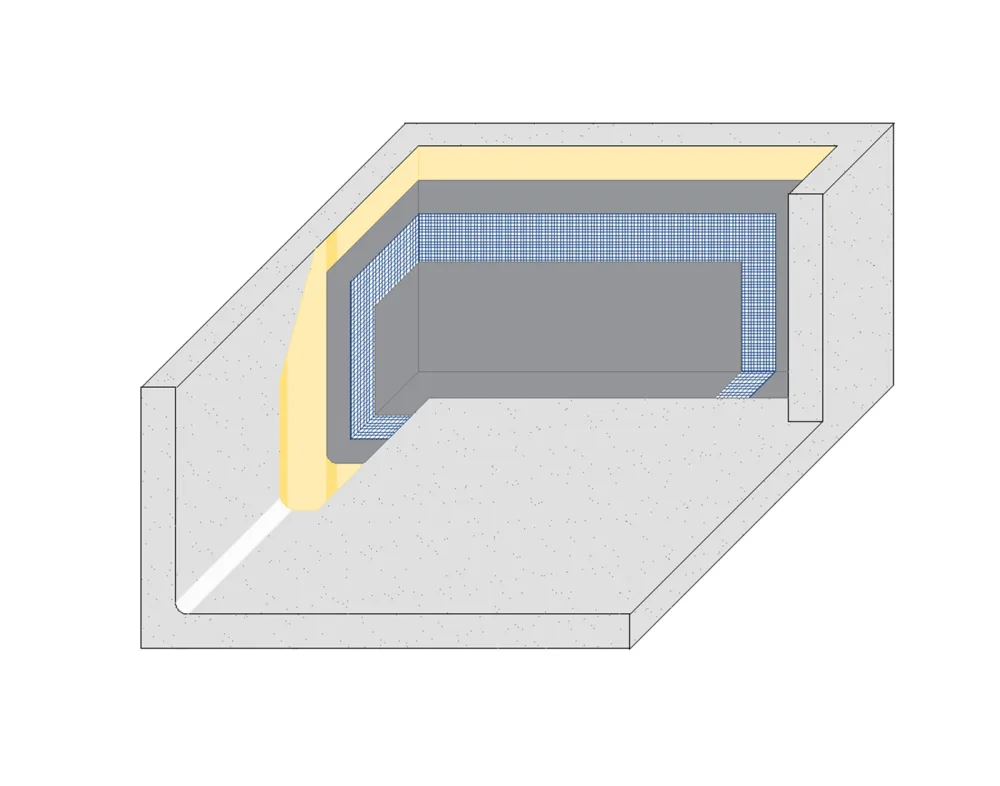
DETAIL
The requirements for these cases are multiple: in addition to durability, tested by permanent contact with water, it is often necessary for the waterproofing treatment to also resist counterthrust actions, as in the case of underground tanks. Furthermore, in the case of tanks in food industries, tanks, pipelines and aqueducts, it is necessary for the waterproofing material to be certified for contact with drinking water.
PRODUCTION
Made in Italy
DOWNLOADS
↓ Application Sheet
↓ Construction Detail
SUBSTRATE CLEANING
Completely remove loose, flaking, or otherwise unstable material, dust, grease, rust, release agents, varnishes, cement laitance, and any other substances or materials that could impair the adhesion of subsequent coatings. Where water ingress or general seepage occurs, treat the substrate with BETONFIX WW mortar. Use the same mortar to create rounded joints between vertical elements and between vertical and horizontal elements. For further preliminary checks on the structures to be waterproofed, consult the Application Data Sheets for the processes in question.
WATERPROOFING
Spread the BETONFIX 300 mortar mixed with KIMITECH ELASTOFIX and immediately apply the KIMITECH 350 mesh, making sure to completely embed it in the mortar. Once the first layer has hardened, and in any case no sooner than 24 hours later, apply a further coat of BETONFIX 300 mixed with KIMITECH ELASTOFIX.
COMPLETION OF OPERATIONS
- Contact with drinking water : After at least 7 days, apply a double coat of Kimitech K40 AP White, a non-toxic, solvent-free two-component epoxy resin, suitable for contact with drinking water, using a brush or roller.
- Contact with food liquids : After at least 7 days, apply a double coat of Kimitech K40 AP Yellow, a non-toxic two-component epoxy resin, suitable for contact with drinking water and food liquids, using a brush or roller.
- Contact with aggressive products : After at least 7 days, apply a double coat of KIMICOVER 301 NF two-component aliphatic polyurethane resin, with excellent resistance to chemical attack and wear, using a brush or roller. For highly aggressive liquids or products, it is advisable to apply a sacrificial coating consisting of a cast of KIMITECH EP-IN epoxy resin reinforced with KIMITECH S100 fiberglass mat.
APPLICATION
CONTACT WITH DRINKING WATER
After at least 7 days, apply a double coat of Kimitech K40 AP White, non-toxic, solvent-free two-component epoxy resin with a brush or roller, suitable for contact with drinking water. Respect the consumption rates indicated in the Technical Data Sheet.
CLEANING OF THE SUBSTRATE
The cleaning operations are aimed at the total elimination of inconsistent parts, which are detached and not equipped with sufficient mechanical characteristics, dust, grease, rust, release agents, paint and varnish, cement slurry and any other substance or material that may affect the adherence of subsequent coatings.
CONTACT WITH AGGRESSIVE PRODUCTS
After at least 7 days, apply a double coat of Kimicover 301 NF two-component aliphatic polyurethane resin with excellent resistance to chemical aggression and wear. Respect the consumption rates as per the Technical Data Sheet. In the case of sewage or very aggressive products, it is advisable to create a sacrificial coating consisting of a jet of Kimitech EP-IN epoxy resin reinforced with Kimitech S100 glass fiber mat.
CONTACT WITH FOOD LIQUIDS
After at least 7 days, apply a double coat of non-toxic twocomponent epoxy resin Kimitech K40 AP GIALLO with a brush or roller, suitable for contact with drinking water and food liquids. Respect the consumption rates indicated in the Technical Data Sheet
PRELIMINARY CHECKS
For retaining walls, elevator shafts and structures subject to positive and negative hydraulic pressures, proceed as follows:
- Verify the presence of sealing elements in correspondence with connecting and fractioning joints;
- Eliminate any obstacles (walls, metal guides, etc.) that could prevent the continuity of the waterproofing coating;
- Create connecting gutters, collection and evacuation systems in correspondence with water coming-in points (to be treated after the creation, at the exit point of water, of a dovetail opening and its subsequent closure with Betonfix WW);
- Apply mortar Betonfix WW directly on the surface in the case of widespread exudation on the surface.
WATERPROOFING
Soak the mesh by applying, with a trowel, mortar Betonfix 300, mixed with 35% by weight of Kimitech ELASTOFIX with a mortar consumption of about 1,5 kg/m². In order to prepare the mixture, stir the product for about 5 minutes with a cement mixer or, in case of small quantities, with drill and whisk. Add 3/4 of Kimitech ELASTOFIX and then, gradually, the remaining product until you get the right consistency. Once obtained a homogeneous mixture free of lumps, make it rest for 10 minutes.
Once the first layer has cured, not before 24 hours have passed, apply with a trowel a second layer of mortar Betonfix 300 mixed with 35% by weight of Kimitech ELASTOFIX with a mortar consumption of about 2 kg/m². In order to allow the correct curing of the mortar, in the case of procedures inside closed tanks, it is essential to ensure adequate forced ventilation (if the structure has 2 openings quite far from each other, typically, we suggest that you place a suction pipe at an opening, letting the air enter the other side. If there is only one opening, the suction pipe is placed into the tank, leaving the suction nozzle at the bottom of it, on the opposite side of the opening).